
Automotive Advertising: Driving Leads to Dealerships

On this page
The automotive industry has changed.
Car buyers are not disappearing from showrooms.
They are just arriving later in the journey.
People still want to sit in the car. They still want to see the colour in daylight. They still want to speak to a real person before making a big decision.
But the journey starts long before they walk into the showroom.
Most buyers now research online first. They compare models. They check reviews. They look at finance options. They search for local dealerships. They want to know who has the right car, at the right price, close to home.
By the time someone contacts a dealership, they may already have compared vehicles, checked stock, read reviews, looked at finance examples and decided which businesses feel worth speaking to.
That means automotive advertising has one clear job.
It needs to make your dealership the obvious choice before the buyer speaks to anyone.
It should not just bring traffic. It should bring buyers. It should help real people make confident decisions.
Automotive buyers compare models, prices, reviews, finance options and local availability before deciding who to contact. Be visible before they make that choice.
What Makes Automotive Advertising Different?
Automotive advertising is not like promoting a low-cost product.
The decision is bigger. The buying journey is longer. The lead quality matters more than the lead volume.
A dealership does not just need more enquiries.
It needs the right enquiries.
Someone may fill in a form, but that does not always mean they are a serious buyer. They may be too far away. They may not be finance-ready. They may be enquiring about a vehicle that has already sold. They may be comparing prices with no real intention to visit.
That is why automotive campaigns need to be built around buyer intent, vehicle availability and local trust.
A strong dealership campaign should focus on:
This is where many automotive campaigns go wrong.
They chase clicks or low-cost leads without checking whether those leads are likely to become conversations, test drives, reservations or sales.
Good automotive advertising connects the full journey.
The ad matters. The stock page matters. The call tracking matters. The follow-up process matters. The dealership reputation matters.
A lead is not won at the click.
It is won when the buyer feels confident enough to take the next step.
The Research Funnel
Automotive buying follows a clear path.
People rarely wake up and search for one dealership first. They usually begin with a need.
They need a bigger family car. They need a reliable used car. They need a van for work. They want to replace a car that is costing too much to run. They may be thinking about switching to electric. They may want a lower monthly payment.
That is why your advertising must match the buyer journey.
Each stage has a different purpose.
At the awareness stage, the buyer is learning. They are open to ideas. They may not know which make, model or fuel type is right for them.
At the consideration stage, they are comparing. They want answers. They want clear differences. They want to know what suits their lifestyle, budget and needs.
At the decision stage, they are ready to act. They search for stock, finance, test drives, part exchange and local dealerships.
This is where many dealers lose leads.
They advertise only at the end of the journey. By then, the buyer may already trust another dealership.
Strong automotive marketing starts earlier. It builds confidence before the enquiry.
That does not mean every dealership should spend heavily on broad research terms. It means the advertising, content and landing pages should support buyers at the stage they are already in.
A person searching for "best used SUV for families" needs guidance.
A person searching for "used BMW X3 Edinburgh" needs stock.
A person searching for "book BMW X3 test drive near me" needs a direct action.
The closer the campaign matches the buyer's stage, the better the experience becomes.
Channel Strategy
For dealerships and automotive brands, each channel has a clear role.
Google Ads
For bottom-funnel search capturing demand.
YouTube Ads
For vehicle showcases to help people see the vehicle before they visit.
Meta Ads
For inventory promotion, demand creation and remarketing.
Google Ads is usually the strongest channel for direct enquiries.
It captures people searching for specific vehicles, local dealerships, test drives, used cars, finance and part exchange.
These searches show intent. The person is not just browsing. They are often close to taking action.
Google Ads can work well for:
YouTube Ads can help people see the vehicle before they visit. This is useful for new models, premium vehicles, electric cars and stock that needs more explanation.
A good video does not need to be overproduced. It needs to be clear. Show the car. Show the interior. Show the space. Explain the key features. Make the next step simple.
Meta Ads are useful for demand creation and remarketing.
They work well when you have strong images, clear offers and specific stock. They can also help bring people back after they have viewed a vehicle page but not enquired.
Microsoft Ads can also perform well for automotive campaigns, especially where the audience has stronger desktop usage, higher income, or a more research-led buying process.
The best results often come when these channels work together.
Search captures demand. Social creates and reminds demand. Video builds trust. Remarketing brings people back when they are ready.
New Car and Used Car Campaigns Should Not Be Treated the Same
New car campaigns and used car campaigns need different strategies.
New car campaigns are often more model-led.
The buyer may care about availability, trim levels, finance offers, delivery times, manufacturer incentives, electric range, warranty and test drives.
Used car campaigns are usually more stock-led.
The buyer may care about price, mileage, registration year, condition, service history, warranty, location and whether the vehicle is still available.
That means the campaign structure, ads and landing pages should be different.
| Campaign Type | Main Focus | Best Landing Page |
|---|---|---|
| New car | Model, offer, finance, test drive | Model page |
| Used car | Stock, price, mileage, location | Vehicle page or filtered stock page |
| Electric vehicles | Range, charging, running costs | EV guide or model page |
| Vans and commercial | Payload, finance, business use | Commercial vehicle page |
| Aftersales | MOT, servicing, tyres, repairs | Service booking page |
A used car buyer does not want a generic brand page when they clicked on a specific vehicle.
A new car buyer may need more explanation before they book a test drive.
An electric vehicle buyer may need answers about range, charging and running costs.
A van buyer may care more about practicality, payload and business finance.
Good automotive advertising reflects those differences.
It does not force every buyer through the same page.
Campaign Structure
A good campaign structure should reflect how people buy.
It should separate high-intent searches from early research. It should separate new cars from used cars. It should separate brand searches from conquest searches. It should also separate local dealership searches from broader model searches.
This makes performance easier to read. It also helps budgets work harder.
| Stage | Keywords | Bid Strategy |
|---|---|---|
| High Intent | Model + dealer | Maximise conversions |
| Mid Funnel | Model comparisons | Target CPA |
| Top Funnel | Category terms | Maximise clicks |
High-intent campaigns should focus on people who are ready to contact the dealership.
These keywords may include:
Mid-funnel campaigns should help buyers compare options.
These searches may not convert straight away, but they influence the decision.
Examples include:
Top-funnel campaigns should be handled carefully.
They can bring useful traffic, but they can also waste budget if the landing page is weak. If someone searches for "best family SUV", they need a helpful page. They do not need a generic stock page with no guidance.
Good structure protects the budget.
It also improves lead quality.
The campaign structure should also separate different commercial goals.
A dealership may need separate campaigns for:
This makes it easier to understand what is actually driving value.
If all traffic is mixed together, the data becomes harder to trust.
Vehicle Listing Ads
Google Vehicle Listing Ads show inventory directly in search.
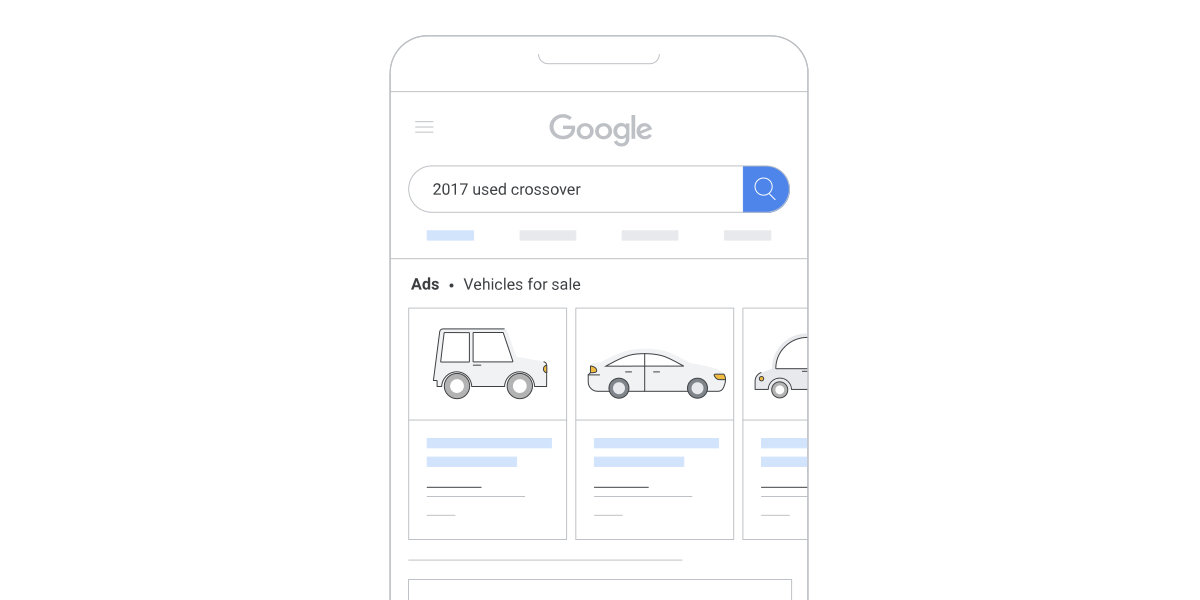
This is powerful because car buyers want detail.
They want to see price. They want mileage. They want location. They want photos. They want availability. They want to know if the vehicle is worth their time before they call.
Connect your inventory feed to enable this format.
The feed should be accurate. Prices should be up to date. Images should be clear. Vehicle details should match the website.
If the feed is poor, the campaign will suffer.
If the website is slow, the campaign will suffer.
If the stock pages do not answer basic questions, the campaign will suffer.
Vehicle Listing Ads work best when the full journey is joined up.
That means the ad, the stock page, the call to action and the sales process all need to support the buyer.
A strong vehicle feed should include:
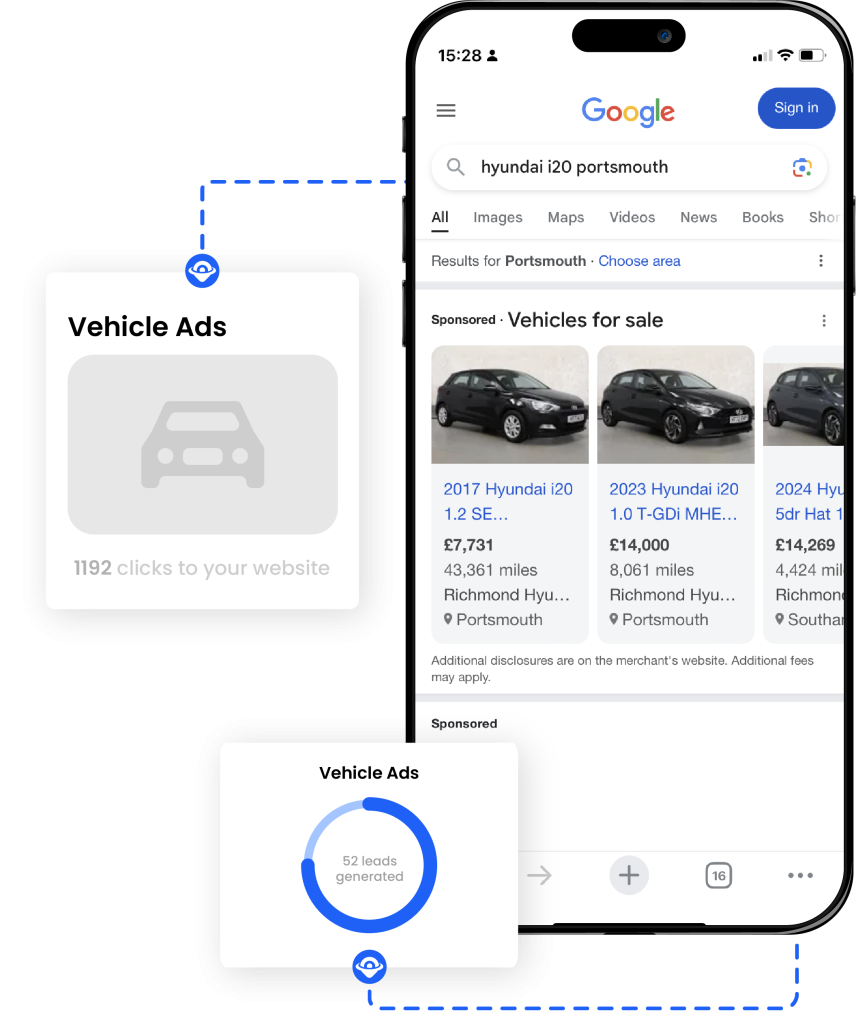
Inventory accuracy matters.
Few things damage trust faster than a buyer clicking on a vehicle that is no longer available, listed at the wrong price, or missing key information.
For dealerships, feed quality is not a technical detail.
It is part of the sales experience.
The Stock Page Matters as Much as the Ad
Many automotive campaigns fail after the click.
The buyer clicks because the vehicle looks relevant. Then the landing page makes them work too hard.
A strong vehicle page should answer the questions a buyer would normally ask before calling.
The page should make the decision easier.
A buyer should not have to search for the price. They should not have to guess whether finance is available. They should not have to struggle to find the phone number. They should not have to wonder where the vehicle is located.
Small page issues can create big campaign problems.
If the call to action is weak, conversion rates drop.
If the page is slow, buyers leave.
If the vehicle details are thin, trust falls.
If the dealership location is unclear, local buyers hesitate.
The best advertising cannot fully fix a poor stock page.
Before increasing spend, dealerships should check whether their vehicle pages are actually helping buyers take action.
Local Focus
Automotive is a local market.
Most people want a dealership they can visit without too much effort. They want to see the car, speak to the team and know where they are buying from.
That makes local targeting important.
Do not waste budget on areas that are too far away unless there is a clear reason. A rare vehicle, a premium model or a strong finance offer may justify wider targeting. Most standard stock will not.
Location targeting should reflect real buyer behaviour.
Use local campaigns around your dealership, nearby towns, commuting routes and areas where previous customers already come from.
Your ads should also include local signals.
Mention the city. Mention the region. Mention test drives. Mention local stock. Mention part exchange. Mention finance options where relevant.
Examples of local intent include:
Strong local advertising helps both SEO and AI discovery.
Search engines and AI systems need to understand who you serve, where you operate and what you offer.
That means your website should make this clear.
You need strong location pages. You need clear stock pages. You need useful FAQs. You need consistent business details. You need a strong Google Business Profile.
For automotive AEO and GEO, the goal is simple.
Answer the questions real buyers ask.
These may include:
Clear answers help people.
They also help search engines, AI assistants and answer engines understand your business.
Lead Volume Is Not the Same as Lead Quality
A dealership can reduce cost per lead and still waste money.
The better question is not always:
“How many leads did we get?”
It is:
How many enquiries turned into serious conversations, test drives, finance applications, reservations or vehicle sales?
Good automotive advertising should be measured beyond form submissions.
Useful signals include:
This helps you see which campaigns are producing real buyers, not just cheap leads.
A low-cost lead is not always a good lead.
A more expensive enquiry can be more valuable if it comes from someone local, interested in a specific vehicle, ready to arrange finance and likely to visit the dealership.
That is why campaign optimisation should not rely on cost per lead alone.
The sales team should feed back what happened after the enquiry.
Did the person answer the phone?
Were they interested in the vehicle?
Did they book a test drive?
Did they have a realistic budget?
Did they buy?
Without this feedback, advertising platforms only see the first step. They do not understand which leads were actually valuable.
Do Not Ignore Phone Calls
Automotive buyers often prefer to call.
They may want to check if the vehicle is still available, ask about finance, confirm part exchange options or arrange a test drive.
That means call tracking matters.
At minimum, dealerships should track:
A campaign may look weak in form submissions but strong in phone enquiries.
Without call tracking, that value can be missed.
Missed calls are also important.
If the campaign is driving calls but the dealership is not answering them, the advertising may be doing its job. The problem may be operational rather than media-related.
That is why dealership reporting should connect marketing data with sales activity.
Clicks, calls, forms, test drives and sales should be reviewed together.
Where Should the Budget Go?
Not every campaign deserves the same budget.
A dealership with limited budget should usually prioritise the areas closest to revenue first.
| Priority | Campaign Type | Why It Matters |
|---|---|---|
| Highest | Brand, local dealer, stock, test drive and finance searches | These buyers are close to taking action |
| Medium | Model comparisons, competitor searches, remarketing and YouTube views | These influence buyers before they enquire |
| Lower | Broad research searches | These can work, but need strong content and enough budget |
The goal is not to be everywhere.
The goal is to be visible where the buyer is most likely to take the next step.
A small dealership may get better results from a focused local campaign than from spreading budget across too many channels.
A larger dealership group may need a broader structure, with different campaigns for locations, brands, vehicle categories and aftersales.
Budget should follow commercial value.
If used cars are the biggest opportunity, campaigns should support used stock.
If aftersales has spare capacity, servicing and MOT campaigns may deserve more budget.
If electric vehicles need education, content and video may play a bigger role.
The right budget split depends on stock, location, margin, sales targets and buyer demand.
Remarketing for Automotive Buyers
Car buyers often return several times before enquiring.
They may view the same vehicle more than once. They may compare similar models. They may check finance and then come back later. They may show the page to someone else before making a decision.
Remarketing helps bring these buyers back.
It can be used to reach people who:
The message should match the behaviour.
Someone who viewed a specific used car may need a reminder about that vehicle or similar stock.
Someone who viewed finance pages may need a clearer finance message.
Someone who watched a video may be ready to book a test drive.
Remarketing should not feel like chasing people around the internet.
It should be useful, relevant and specific.
Aftersales Advertising
Automotive advertising is not only about selling vehicles.
Aftersales can also be a strong revenue driver.
Servicing, MOTs, tyres, repairs and seasonal checks can bring existing and new customers back to the dealership.
Aftersales campaigns can work well because the intent is often clear.
People search when they need something.
Examples include:
Aftersales campaigns should make booking easy.
The landing page should show the service, location, pricing where possible, availability and booking options.
For dealership groups, aftersales campaigns can also support customer retention.
Someone who bought a vehicle may return for servicing if the follow-up journey is clear.
Common Automotive Advertising Mistakes
Many dealership campaigns do not fail because the channel is wrong.
They fail because the basics are not connected.
Fixing these issues can often improve performance before increasing the budget.
A campaign does not always need more spend.
Sometimes it needs cleaner tracking, better stock pages, tighter targeting or faster follow-up.
Reporting That Dealerships Can Actually Use
Automotive reporting should not stop at impressions, clicks and conversions.
Those numbers matter, but they do not tell the full story.
A useful dealership report should show:
Reporting should help the dealership make decisions.
Should more budget go to used SUVs?
Are finance enquiries increasing?
Are calls being missed?
Are certain locations underperforming?
Are ads generating interest in vehicles with poor availability?
Are buyers clicking but not enquiring?
Good reporting gives the sales and marketing teams the same view of performance.
That is where advertising becomes more useful.
AEO and GEO for Dealerships
Search is changing.
People are not only using traditional search results. They are also using AI tools, answer engines and search features that summarise information before someone clicks.
That makes clarity even more important.
Dealership websites need to explain who they are, where they are, what they sell and how buyers can take the next step.
For automotive AEO and GEO, your content should answer direct buyer questions.
Examples include:
This is not only useful for SEO.
It also helps AI systems understand your dealership and include you in relevant answers.
The clearer your website is, the easier it becomes for buyers and search systems to understand what you offer.
Automotive Advertising FAQ
Get Expert Help
Automotive advertising is not just about clicks.
It is about trust.
A buyer is making a serious decision. They are spending thousands of pounds. They may be arranging finance. They may be replacing a family car. They may be buying their first vehicle.
Your marketing should respect that.
It should be clear. It should be useful. It should be local. It should make the next step easy.
The dealerships that win are not always the ones shouting the loudest.
They are the ones that appear at the right moment, with the right answer, and a clear reason to get in touch.
If your campaigns are getting clicks but not enough serious enquiries, check the stock pages, call tracking, vehicle feed, location targeting and follow-up process before increasing budget.
Request a free audit if you want a clearer view of where your dealership marketing is losing buyers.
Next Best Step
Where to go from here
Google Ads Management
Explore our professional Google Ads management services.
Google Ads Guide
Master Google Ads with our free, comprehensive educational curriculum.
Automotive Strategy
Learn about tailored advertising strategies specifically built for the Automotive vertical.
About the Author
Kiril Ivanov is a digital marketing specialist with experience managing local, national and international campaigns for businesses ranging from growing independent companies to major consumer brands. His background includes leading advertising automation work for Michael Kors and working on campaigns involving Canon, Dormeo, esure, DLG Group, Village Gym, Cameron House, Crerar Hotels, Cromlix Hotel, Harrison Fund and the Advertising Standards Authority. His experience spans paid search, paid social, advertising automation, SEO, conversion optimisation and wider digital strategy across hospitality, retail, financial services, professional services and other competitive sectors.
Need this implemented for you?
Read the guide, or let our specialist team handle it while you focus on the big picture.
Get Your Free Audit